
The Global Food Processor’s Guide to Onion Powder, Garlic Powder, and Tomato Powder: Quality, Consistency, and Scale with Shreemzo Exim
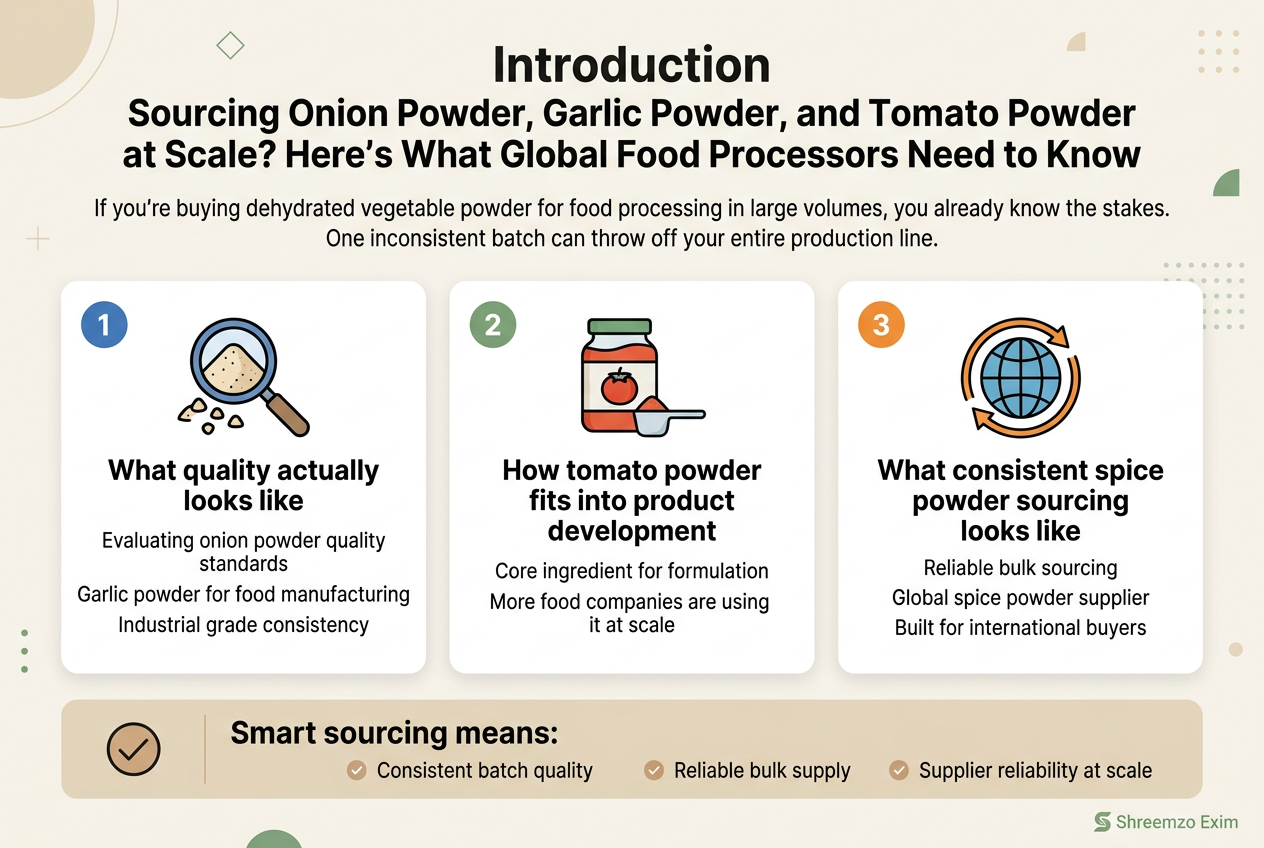
Sourcing Onion Powder, Garlic Powder, and Tomato Powder at Scale? Here’s What Global Food Processors Need to Know
If you’re buying dehydrated vegetable powder for food processing in large volumes, you already know the stakes. One inconsistent batch can throw off your entire production line — and finding a reliable bulk onion powder supplier or tomato powder wholesale exporter who actually delivers on quality, not just price, is harder than it sounds.
This guide is written for food manufacturers, product developers, and procurement teams who are scaling up and need straight answers about sourcing.
We’ll cover three things that matter most to industrial buyers:
What quality actually looks like when you’re evaluating onion powder quality standards and garlic powder for food manufacturing at an industrial grade
How tomato powder fits into product development and why more food companies are treating it as a core ingredient, not an afterthought
What consistent spice powder sourcing looks like in practice — and how Shreemzo Exim operates as a global spice powder supplier built for international buyers who need reliability at scale
No fluff. Just the stuff you need to make a smarter sourcing decision.
Why Dehydrated Powders Are the Backbone of Global Food Processing
The Growing Demand for Shelf-Stable Flavor Ingredients
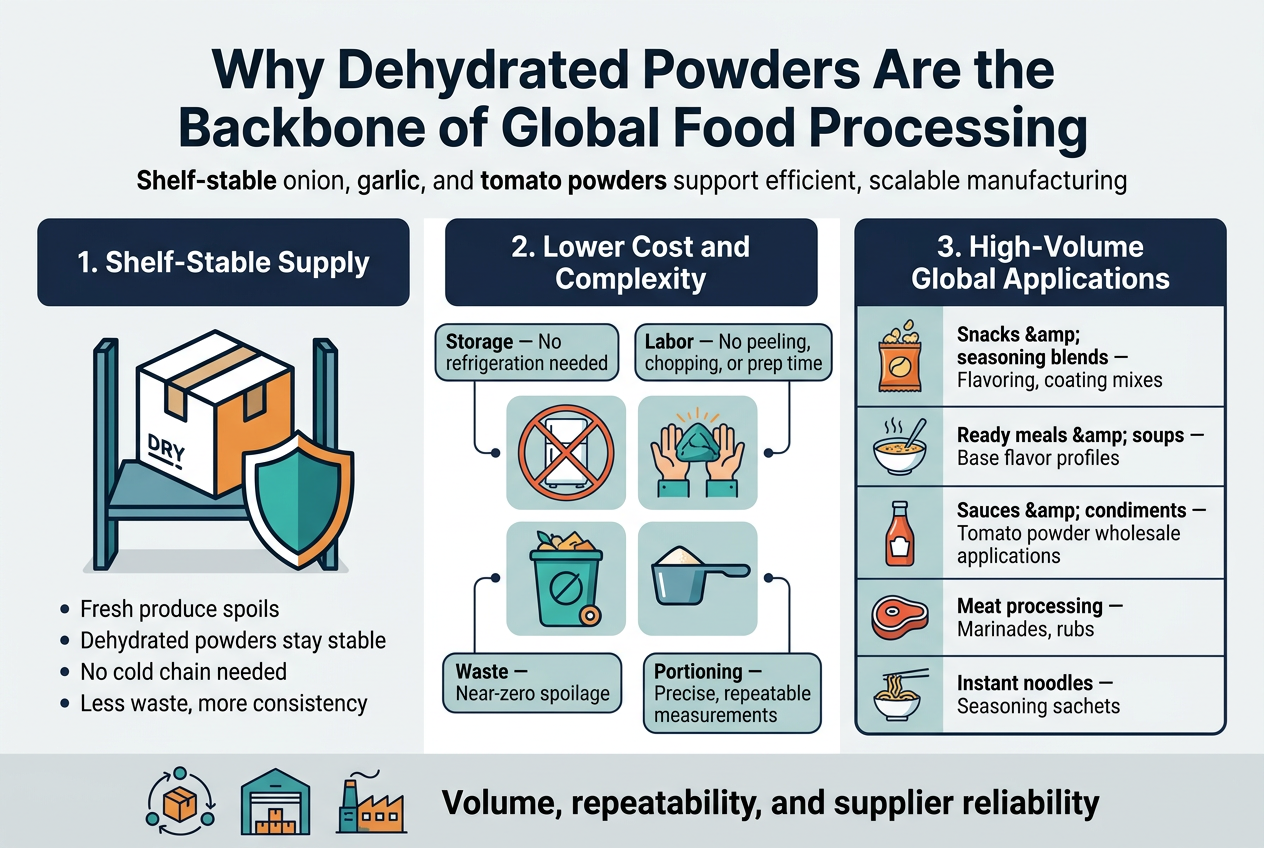
Fresh produce spoils. Dehydrated vegetable powder for food processing doesn’t. That’s the core reason global manufacturers keep coming back to onion, garlic, and tomato powders — they deliver consistent flavor without the cold chain headaches, waste, or unpredictable quality that fresh ingredients bring.
With supply chain disruptions still fresh in industry memory, shelf stability has shifted from a convenience to a strategic priority.
How Onion, Garlic, and Tomato Powders Reduce Cost and Complexity
Switching to dehydrated powders cuts multiple operational costs at once:
Storage — No refrigeration needed; standard dry warehousing works
Labor — No peeling, chopping, or prep time on production lines
Waste — Near-zero spoilage compared to fresh inputs
Portioning — Precise, repeatable measurements every batch
For manufacturers buying dehydrated onion powder in bulk or sourcing industrial garlic powder grade ingredients, these savings scale significantly across high-volume production runs.
Key Industries Driving Volume Purchases Worldwide
Consistent spice powder sourcing is critical across several sectors:
| Industry | Primary Use |
|---|---|
| Snacks & seasoning blends | Flavoring, coating mixes |
| Ready meals & soups | Base flavor profiles |
| Sauces & condiments | Tomato powder wholesale applications |
| Meat processing | Marinades, rubs |
| Instant noodles | Seasoning sachets |
These industries demand volume, repeatability, and supplier reliability — non-negotiables when production schedules can’t afford inconsistency.
Understanding Onion Powder: What Quality Really Means at Scale
Pungency Levels, Moisture Content, and Color Standards
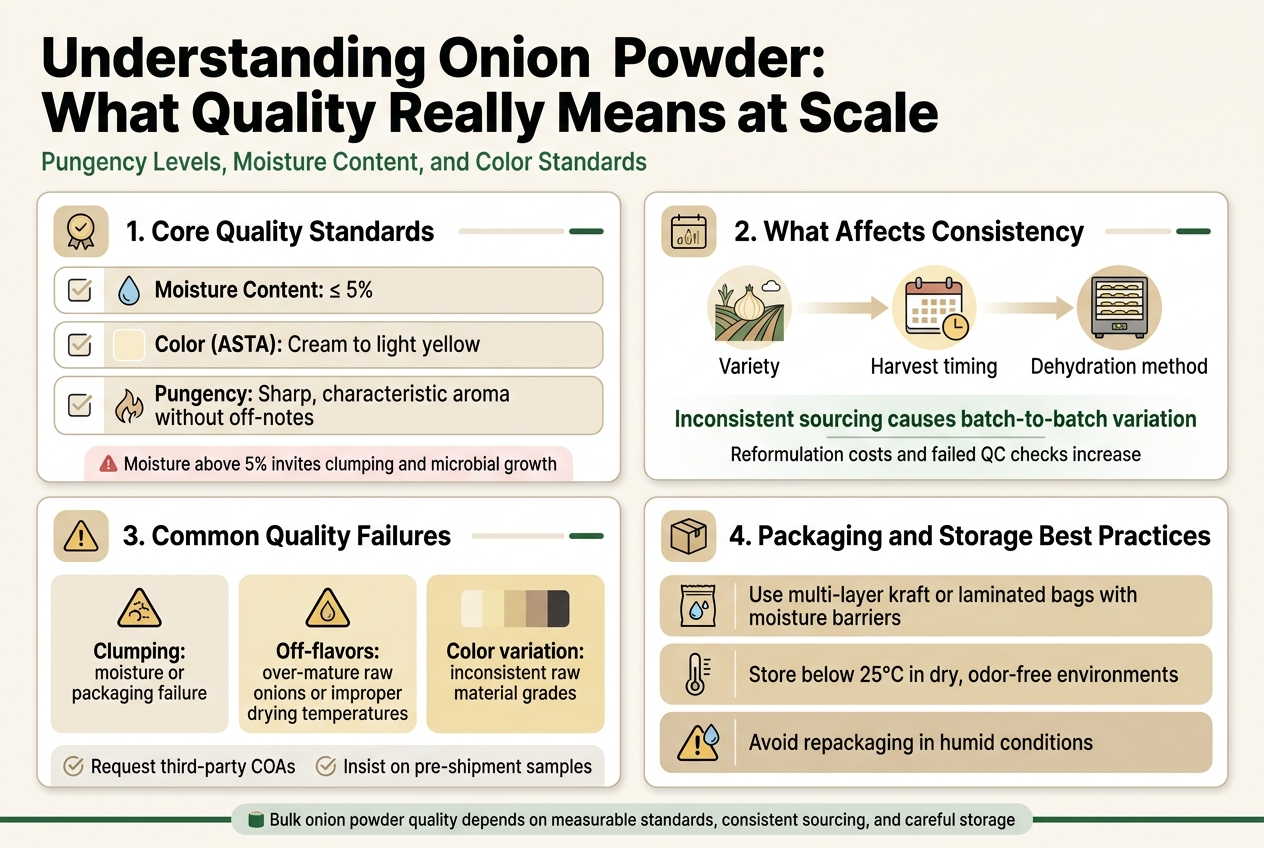
Onion powder quality hinges on three measurable factors every bulk buyer should track closely:
| Parameter | Acceptable Range |
|---|---|
| Moisture Content | ≤ 5% |
| Color (ASTA) | Cream to light yellow |
| Pungency | Sharp, characteristic aroma without off-notes |
Moisture above 5% invites clumping and microbial growth — two problems that kill shelf life fast when you’re dealing with large-volume production runs.
How Raw Material Sourcing Affects Final Product Consistency
The onion variety, harvest timing, and dehydration method all shape what ends up in your blending line. Suppliers who source inconsistently — mixing crop seasons or regions without disclosure — deliver powder that performs differently batch to batch. For food manufacturers, that unpredictability translates directly into reformulation costs and failed QC checks.
Common Quality Failures and How to Avoid Them
Clumping: Almost always a moisture or packaging failure
Off-flavors: Linked to over-mature raw onions or improper drying temperatures
Color variation: Sign of inconsistent raw material grades
Request third-party COAs and insist on pre-shipment samples before committing to bulk onion powder supplier contracts.
Packaging and Storage Best Practices for Bulk Orders
Use multi-layer kraft or laminated bags with moisture barriers
Store below 25°C in dry, odor-free environments
Avoid repackaging in humid conditions
Garlic Powder for Industrial Use: Getting the Grade Right
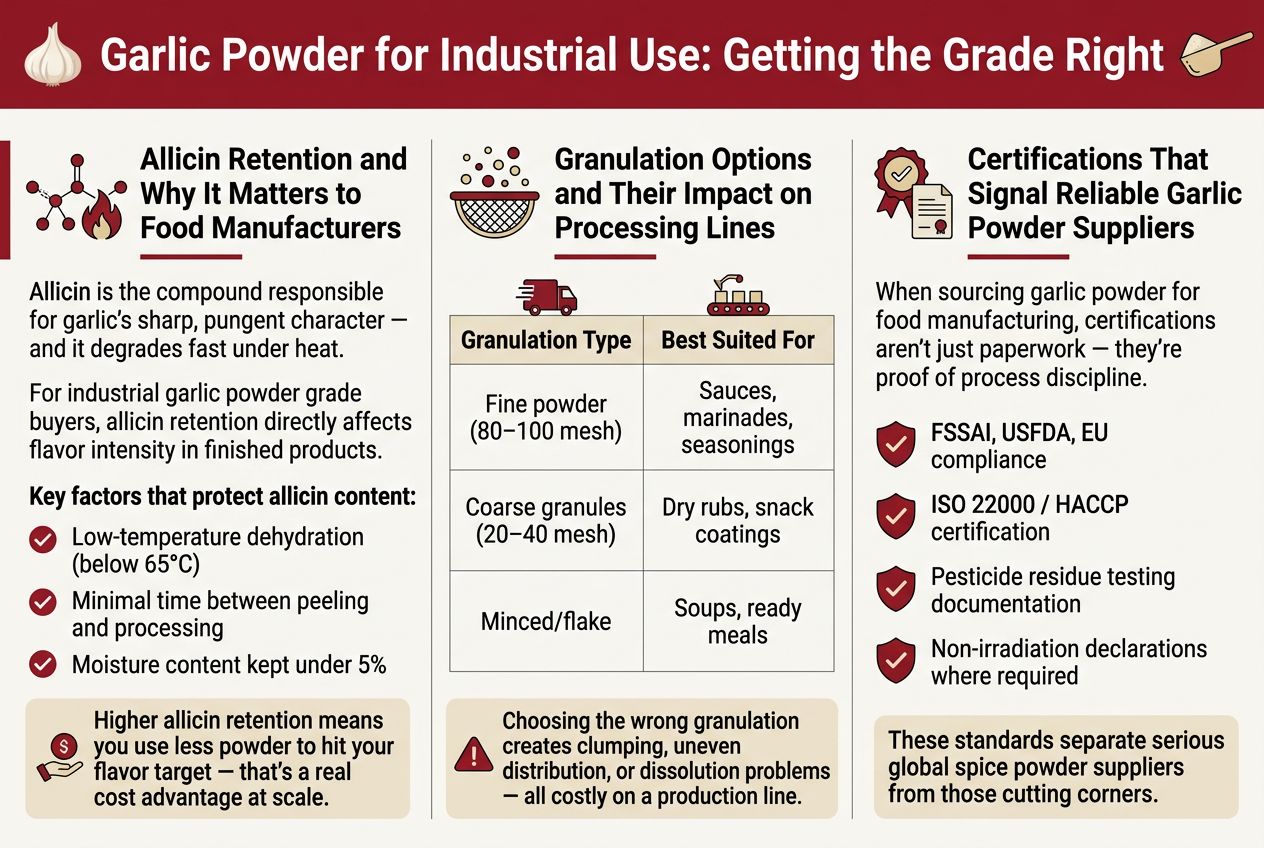
Allicin Retention and Why It Matters to Food Manufacturers
Allicin is the compound responsible for garlic’s sharp, pungent character — and it degrades fast under heat. For industrial garlic powder grade buyers, allicin retention directly affects flavor intensity in finished products.
Key factors that protect allicin content:
Low-temperature dehydration (below 65°C)
Minimal time between peeling and processing
Moisture content kept under 5%
Higher allicin retention means you use less powder to hit your flavor target — that’s a real cost advantage at scale.
Granulation Options and Their Impact on Processing Lines
Garlic powder isn’t one-size-fits-all. Different processing environments need different particle sizes.
| Granulation Type | Best Suited For |
|---|---|
| Fine powder (80–100 mesh) | Sauces, marinades, seasonings |
| Coarse granules (20–40 mesh) | Dry rubs, snack coatings |
| Minced/flake | Soups, ready meals |
Choosing the wrong granulation creates clumping, uneven distribution, or dissolution problems — all costly on a production line.
Certifications That Signal Reliable Garlic Powder Suppliers
When sourcing garlic powder for food manufacturing, certifications aren’t just paperwork — they’re proof of process discipline.
Look for:
FSSAI, USFDA, EU compliance
ISO 22000 / HACCP certification
Pesticide residue testing documentation
Non-irradiation declarations where required
These standards separate serious global spice powder suppliers from those cutting corners.
Tomato Powder as a Strategic Ingredient for Product Developers
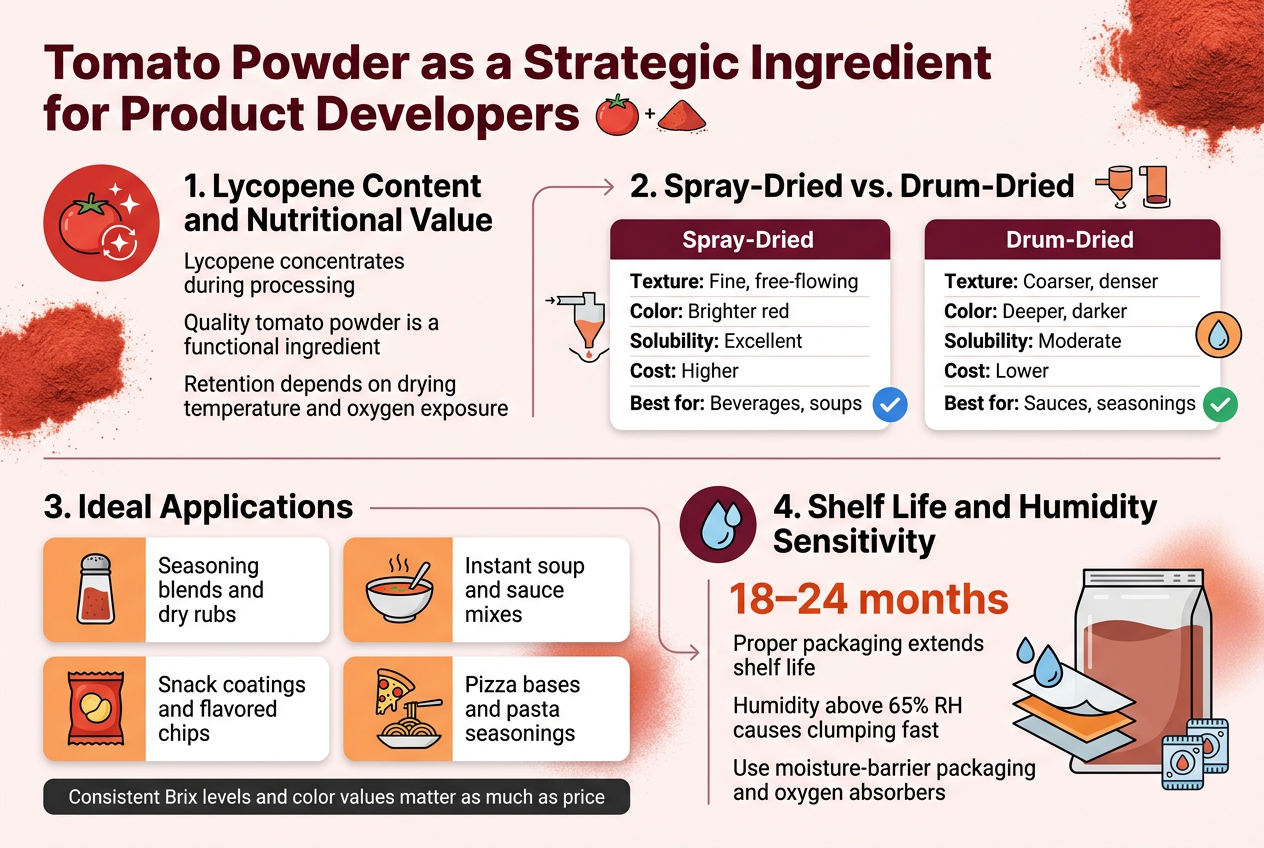
Lycopene Content and Nutritional Value Considerations
Tomato powder carries real nutritional weight. Lycopene — the antioxidant that gives tomatoes their red color — concentrates during processing, making quality tomato powder a genuinely functional ingredient. For product developers working in the tomato powder food industry, lycopene retention depends heavily on processing temperature and oxygen exposure during drying.
Spray-Dried vs. Drum-Dried Tomato Powder Compared
| Feature | Spray-Dried | Drum-Dried |
|---|---|---|
| Texture | Fine, free-flowing | Coarser, denser |
| Color | Brighter red | Deeper, darker |
| Solubility | Excellent | Moderate |
| Cost | Higher | Lower |
| Best for | Beverages, soups | Sauces, seasonings |
Spray-dried powder dissolves cleanly — ideal for instant applications. Drum-dried holds stronger tomato flavor, making it a smart pick for robust savory products.
Ideal Applications Across Sauces, Snacks, and Seasonings
Seasoning blends and dry rubs
Instant soup and sauce mixes
Snack coatings and flavored chips
Pizza bases and pasta seasonings
As a tomato powder wholesale exporter supplying global buyers, consistent Brix levels and color values matter as much as price.
Shelf Life Expectations and Humidity Sensitivity
Properly packaged tomato powder lasts 18–24 months. Humidity is its biggest enemy — clumping happens fast above 65% RH. Moisture-barrier packaging with oxygen absorbers is non-negotiable for bulk shipments.
Consistency and Scale: What Global Buyers Must Demand from Suppliers
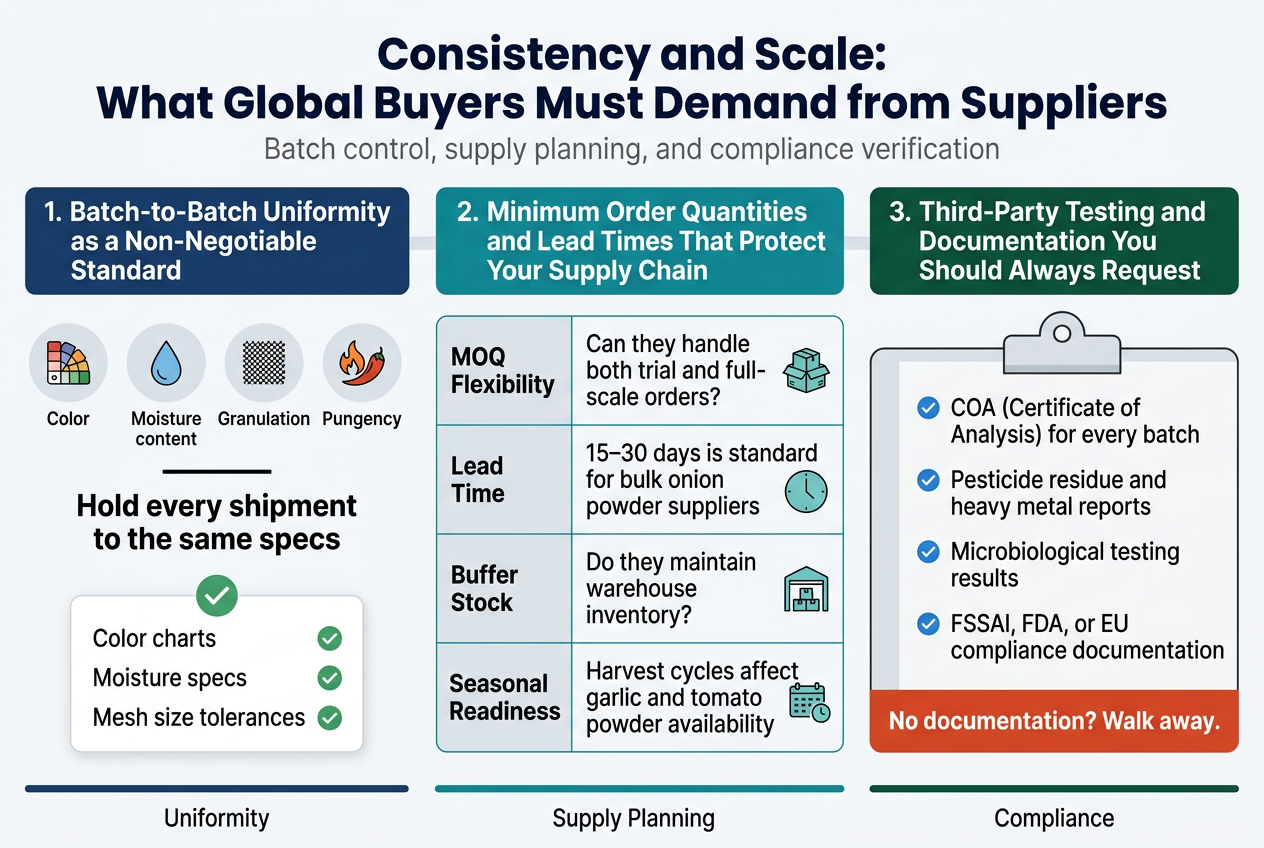
Batch-to-Batch Uniformity as a Non-Negotiable Standard
When you’re running large-scale food production, even minor variation in your dehydrated vegetable powder for food processing can throw off entire product lines. Color, moisture content, granulation, and pungency levels must stay consistent across every shipment. Ask suppliers for color charts, moisture specs, and mesh size tolerances — then hold them to those numbers every single time.
Minimum Order Quantities and Lead Times That Protect Your Supply Chain
| Factor | What to Verify |
|---|---|
| MOQ Flexibility | Can they handle both trial and full-scale orders? |
| Lead Time | 15–30 days is standard for bulk onion powder suppliers |
| Buffer Stock | Do they maintain warehouse inventory? |
| Seasonal Readiness | Harvest cycles affect garlic and tomato powder availability |
Reliable consistent spice powder sourcing means your supplier plans ahead — not just responds to your orders.
Third-Party Testing and Documentation You Should Always Request
Before committing to any tomato powder wholesale exporter or garlic powder for food manufacturing, make sure you’re getting:
COA (Certificate of Analysis) for every batch
Pesticide residue and heavy metal reports
Microbiological testing results
FSSAI, FDA, or EU compliance documentation
No documentation? Walk away.
How Shreemzo Exim Delivers Quality Across International Markets
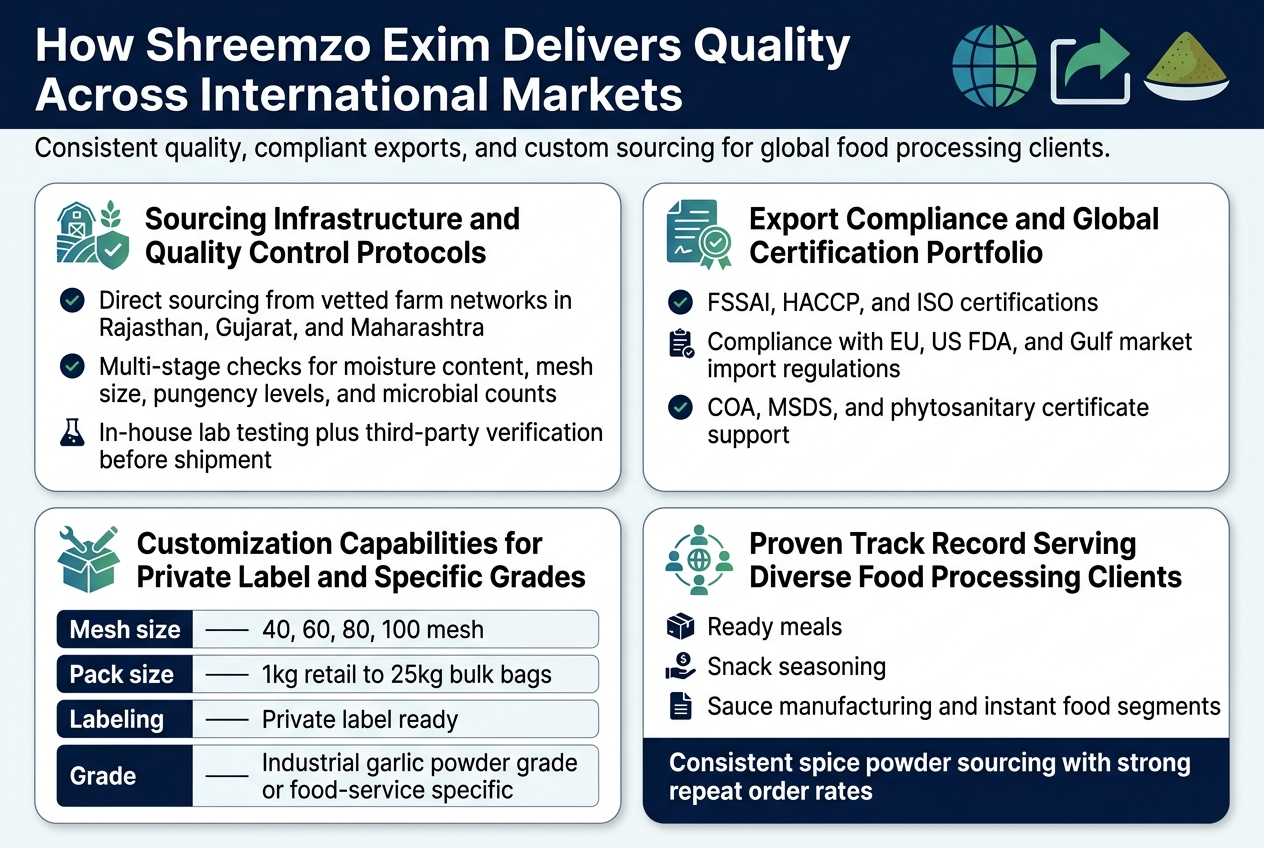
Sourcing Infrastructure and Quality Control Protocols
Shreemzo Exim works directly with vetted farm networks across India’s major producing regions—Rajasthan and Gujarat for onions and garlic, and Maharashtra for tomatoes. Every batch goes through multi-stage quality checks covering moisture content, mesh size, pungency levels, and microbial counts before it leaves the facility.
As a trusted bulk onion powder supplier and tomato powder wholesale exporter, Shreemzo runs in-house lab testing alongside third-party verification to keep standards consistent across every order.
Export Compliance and Global Certification Portfolio
FSSAI, HACCP, and ISO certifications in place
Compliance with EU, US FDA, and Gulf market import regulations
Complete documentation support: COA, MSDS, phytosanitary certificates
Customization Capabilities for Private Label and Specific Grades
Shreemzo handles custom requirements that most generic suppliers can’t match:
| Requirement | Available Options |
|---|---|
| Mesh size | 40, 60, 80, 100 mesh |
| Pack size | 1kg retail to 25kg bulk bags |
| Labeling | Private label ready |
| Grade | Industrial garlic powder grade or food-service specific |
Proven Track Record Serving Diverse Food Processing Clients
Clients across ready meals, snack seasoning, sauce manufacturing, and instant food segments rely on Shreemzo for consistent spice powder sourcing—with repeat order rates that speak for themselves.
Making the Right Sourcing Decision for Long-Term Success
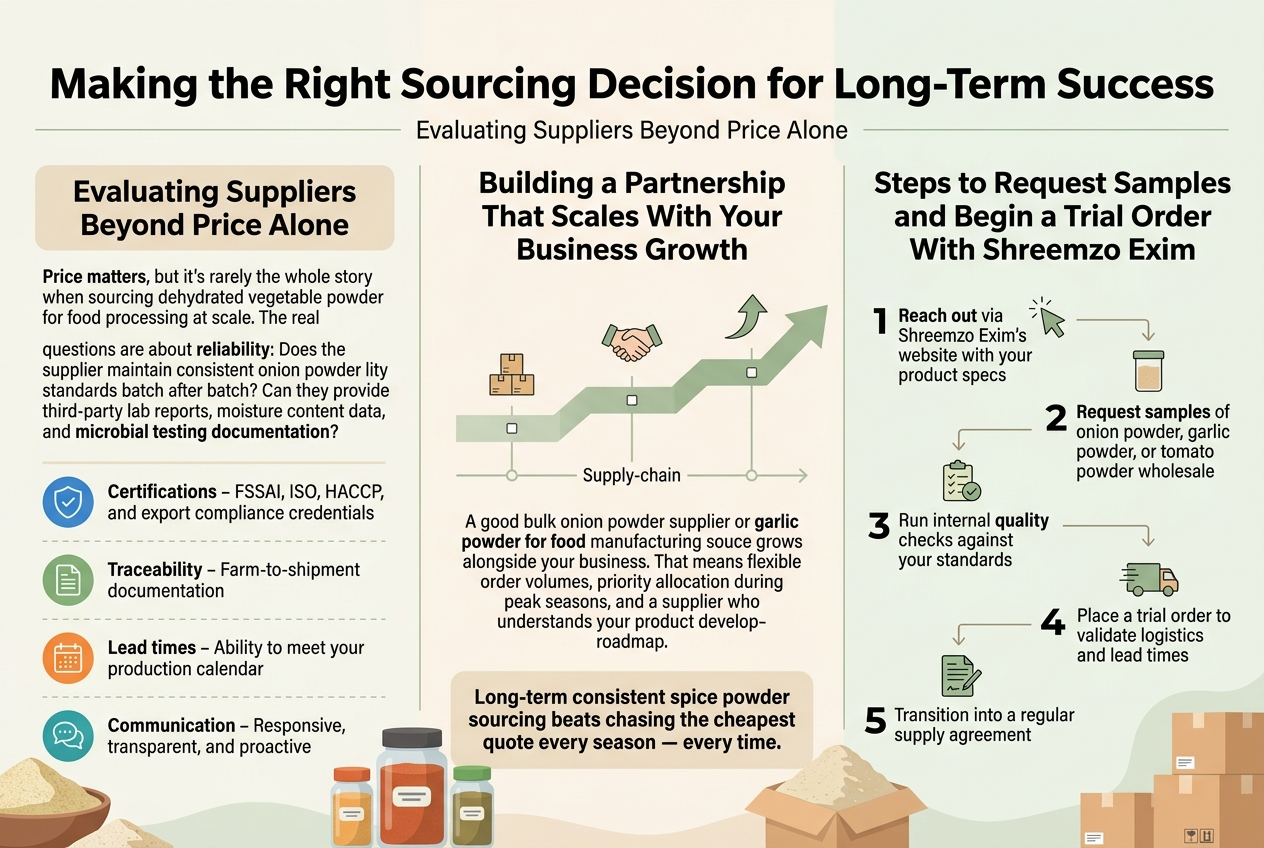
Evaluating Suppliers Beyond Price Alone
Price matters, but it’s rarely the whole story when sourcing dehydrated vegetable powder for food processing at scale. The real questions are about reliability: Does the supplier maintain consistent onion powder quality standards batch after batch? Can they provide third-party lab reports, moisture content data, and microbial testing documentation?
Key factors to weigh:
Certifications – FSSAI, ISO, HACCP, and export compliance credentials
Traceability – Farm-to-shipment documentation
Lead times – Ability to meet your production calendar
Communication – Responsive, transparent, and proactive
Building a Partnership That Scales With Your Business Growth
A good bulk onion powder supplier or garlic powder for food manufacturing source grows alongside your business. That means flexible order volumes, priority allocation during peak seasons, and a supplier who understands your product development roadmap.
Long-term consistent spice powder sourcing beats chasing the cheapest quote every season — every time.
Steps to Request Samples and Begin a Trial Order With Shreemzo Exim
Getting started is straightforward:
Reach out via Shreemzo Exim’s website with your product specs
Request samples of onion powder, garlic powder, or tomato powder wholesale
Run internal quality checks against your standards
Place a trial order to validate logistics and lead times
Transition into a regular supply agreement
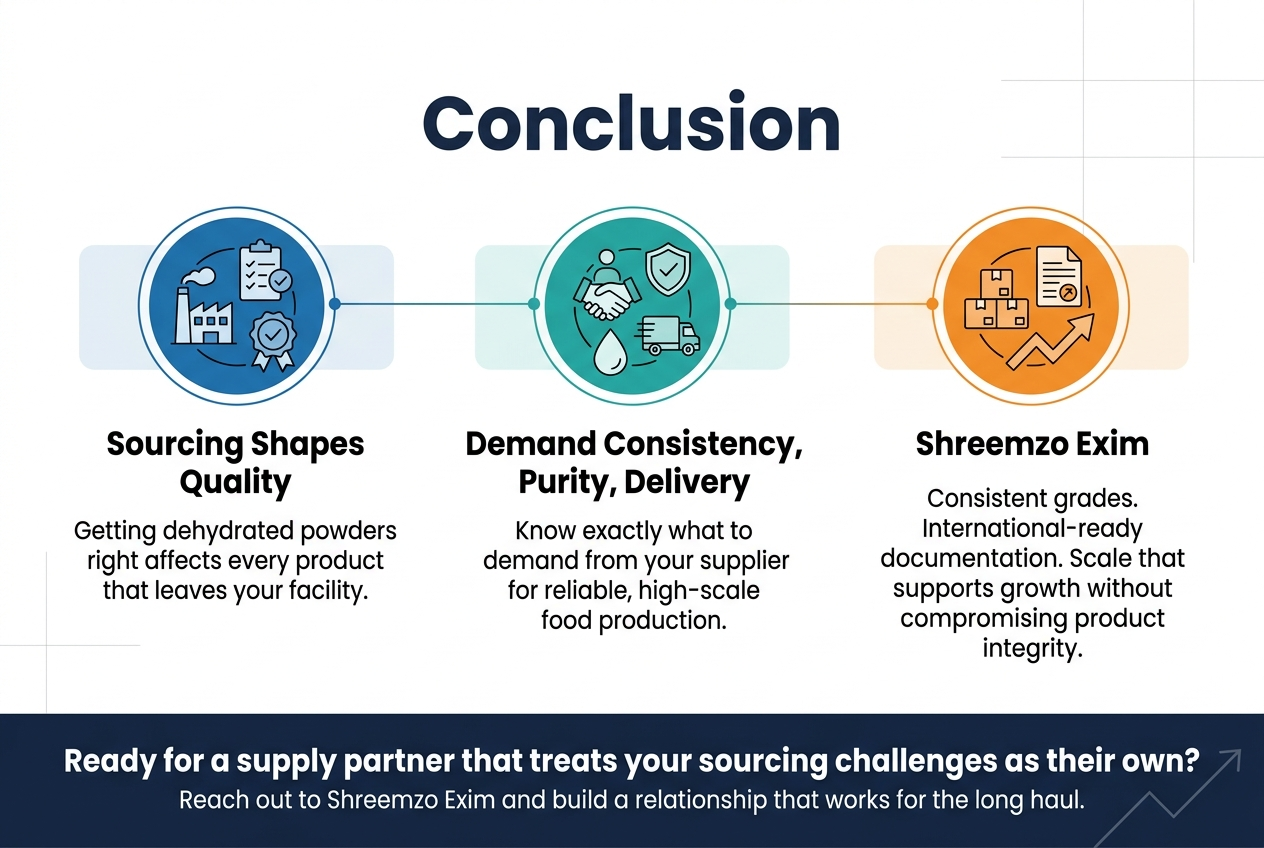
Getting your sourcing right for dehydrated powders like onion, garlic, and tomato isn’t just a procurement decision — it shapes the quality of every product that leaves your facility. From understanding what real quality looks like at scale to knowing exactly what to demand from a supplier in terms of consistency, purity, and reliable delivery, the stakes are high for food processors operating in global markets.
Shreemzo Exim brings the kind of supplier reliability that serious food businesses need — consistent grades, international-ready documentation, and the scale to support your growth without compromising on product integrity. If you’re ready to lock in a supply partner that treats your sourcing challenges as their own, reach out to Shreemzo Exim and start building a relationship that works for the long haul.